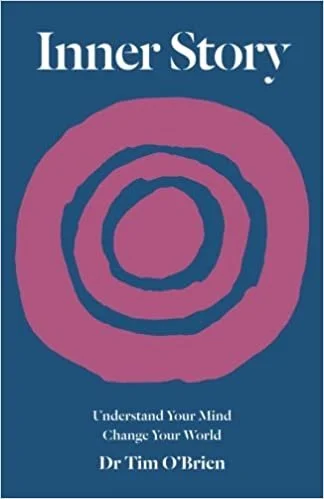
Review of Inner Story by Dr Tim O’Brien
Much has been said recently about the role of psychology in education, particularly in relation to cognition and learning, with discussions focusing on what teachers can learn from some of the psychological principles of this. Inner Story by Dr Tim O’Brien (@Doctob) is not a book about psychology per se. It is also not a book about education. It is a book about people, how people experience the world and how people experience themselves.
Although closest to the self-help style genre, it is well worth educators taking the time to read because it focuses on engaging with internal narratives and understanding how they interrelate and influence an individual. As Tim puts it:
“there are two stories inside your head. One is about your life, the other is controlling your life”
He states that the latter is your inner story. In our settings, we interact with a variety of inner stories every day whilst our own simultaneously chugs along in the background; with greater understanding of what our learners Inner Stories are we will be better placed to support, facilitate and teach.
With a robust professional background in the field, Dr O’Brien is well placed to be writing books about people. Given his strong CV, I was expecting a weightier, wordier style but it is easy reading. Shorter sentences offer time to think making it a text that can be picked up and dipped in and out of. I found this especially helpful because I wanted to come back to certain themes and re-read.
Despite the simpler sentence styles (which create a comfortable reader/writer relationship) the content is deceptively engaging and you’ll find yourself being drawn in to think deeper, partly due to the conversational tone; I found myself internally discussing various education issues, children and situations with Dr Tim as I went through, in addition to putting my own inner story under a lens. This is a main reason I am recommending the book to teachers despite it being from outside the edu-genre.
The process of wider thinking about how and why we interact with the world the way we do leads you to mentally dust all sorts of avenues that you might have awareness of as a Teacher but have never really unpicked. The chapters have been written to standalone as well as gel well together to allow this flexibility and are generally titles beginning with ‘understanding’ or ‘being’. Simple yet complex.
For me, this wasn’t a book to read intensely even though you could go through it pretty quickly if you’re an avid reader. I found that I was thinking of children I’d worked with as I read and feel this is something other education readers will experience. It’s also helped by the numerous anecdotes that Dr Tim offers. By understanding inner stories we are taking time to understand relationships and people; personalness. Small personal activities and reflective questions are scattered throughout, some encouraging a written response and others requiring a thought or action.
The book hasn’t taken a ‘one size fits all’ approach for a mass market and isn’t putting itself forward as a ‘cure all’ which is something I was wary of. My personal bias is that I don’t usually like the sort of self-help styled books for that reason, but this one had me thinking as I went through. It could be argued that perhaps I enjoyed it because my own mindset was open to trying the activities and considering the points, but I think it’s more that there is a lot of content within the book that a reader ends up soaking up. Depending which mindset you approach with, the content can apply to yourself or help you consider how to better support and understand learners within the classroom.
With all the recent talk of well-being, I think a good staff meeting could be planned around various points within this book, not least a reflection on ‘what type of person’ people are. That activity was very simple but potent and could be adapted to what kind of teacher/leader they are.
You don’t have to be interested in using psychology in the classroom to be able to enjoy, learn or engage with the contents of Inner Story for yourself. In my opinion, it has united the threads of applying complex psychological principles that could (should?) underpin practice and the need to recognise that any classroom is made up of individuals, each with an Inner Story that will affect the essence of their education. Delve into behaviour, ability and the relationship with perception of self, sense of place, ‘readiness’ to learn, regulation of stress or emotion - the list goes on…
Each of the above elements could be expanded upon in further detail, especially behaviour, but I’ll leave it to you, readers, to see if you took the same things from the book that I have.